Planning is everything: the FSB’s Key Attributes and what we have learnt from them
7 December 2021
7 December 2021
Ten years since the adoption of the “Key Attributes of Effective Resolution Regimes”, how far have we come and where do we go from here?
This year’s Resolution Report commemorates the tenth anniversary of the FSB Key Attributes of Effective Resolution Regimes for Financial Institutions (“Key Attributes”) which were adopted by the FSB Plenary in October 2011 and endorsed by the G20 at the Cannes Summit in November 2011.
Since their adoption ten years ago, the FSB Key Attributes of Effective Resolution Regimes have set the standard for the reform of resolution regimes and resolution planning across all sectors. While progress towards resolvability has been significant, the FSB´s recent evaluation of the “too big to fail” reforms found that a number of gaps need to be addressed to fully realise the benefits of the resolution reforms. Looking ahead, emerging themes in resolution planning relate to digital innovation, including in relation to reliance on third-party service providers and cloud services and the need to assess resolvability of non-traditional market participants.
Banks – Important work remains to improve the resolvability of global systemically important banks. Work continues on allocation of Total Loss-Absorbing Capacity (TLAC) resources within groups, G-SIBs’ capabilities for access to funding in resolution, valuation and continuity of access in resolution to financial market infrastructures (FMIs). Cross-border issues remain to be addressed for instance in relation to funding in resolution and bail-in execution. The FSB will soon publish a practices paper that summarises the issues on the latter.
Central Counterparties (CCPs) – Uncertainty remains around the resolvability of CCPs given their systemic role in the financial system. A preliminary analytical report on CCP financial resources will be published in early 2022 and will inform options for potential new or revised international policy on the use, composition or amount of financial resources for CCP recovery or resolution.
Insurers – Progress on resolution reforms and resolution planning implementation in the insurance sector has been mixed. As in prior years, some jurisdictions have identified systemically important insurers and/or internationally active insurance groups. Work on resolution planning and resolvability assessments for these institutions has started or is under way. The FSB will soon publish two papers that present practices regarding financial and operational interconnectedness in resolution planning and funding in resolution.
The FSB has also published the data underpinning the Resolution Reform Index which is used in Graph 5 of the Resolution Report. The index illustrates the progress of FSB jurisdictions in adopting comprehensive bank resolution reforms since the global financial crisis. A detailed description of the RRI can be found in Annex F of the March 2021 FSB Report on the Evaluation of Too-Big-To-Fail Reforms.
Datasets from the report are publicly available for use in accordance with the FSB’s normal terms and conditions.
Press enquiries:
+41 61 280 8477
[email protected]
Ref: 41/2021
The Financial Stability Board (FSB) today published its 2021 Resolution Report. This year’s report commemorates the tenth anniversary of the FSB Key Attributes of Effective Resolution Regimes for Financial Institutions (“Key Attributes”) and takes stock of progress made in implementing FSB resolution policies and enhancing resolvability across the banking, financial market infrastructure, and insurance sectors. It also sets out the FSB’s priorities in the resolution area going forward.
Since their adoption ten years ago, the Key Attributes have set the standard for the reform of resolution regimes and resolution planning across all sectors. Progress towards resolvability has been significant, but the FSB´s recent evaluation of the “too big to fail” reforms found that a number of gaps need to be addressed to fully realise the benefits of the resolution reforms. In addition, digital innovation is giving rise to new challenges for resolution planning, including in relation to the reliance on third-party service providers and cloud services, and the need to assess resolvability of non-traditional market participants.
Banks – Work is under way to build up external TLAC for four emerging market economy G-SIBs due to comply with the TLAC standard by January 2025. All other G-SIBs report that they already meet or exceed the final TLAC requirement. Not all G-SIBs consistently disclose information on internal TLAC. Cross-border issues remain to be addressed, for instance in relation to funding in resolution and bail-in execution. The FSB will shortly publish a practices paper that summarises the issues on the latter.
Central Counterparties (CCPs) – Uncertainty remains around the resolvability of CCPs given their systemic role in the financial system. A preliminary report will be published in early 2022 and will inform options for new or revised international policy on the use, composition or amount of financial resources for CCP recovery or resolution.
Insurers – As in prior years, some jurisdictions have identified systemically important insurers and/or internationally active insurance groups. Work on resolution planning and resolvability assessments for these institutions has started or is under way. The FSB will soon publish two papers that present practices regarding financial and operational interconnectedness in resolution planning and funding in resolution.
The FSB coordinates at the international level the work of national financial authorities and international standard-setting bodies and develops and promotes the implementation of effective regulatory, supervisory, and other financial sector policies in the interest of financial stability. It brings together national authorities responsible for financial stability in 24 countries and jurisdictions, international financial institutions, sector-specific international groupings of regulators and supervisors, and committees of central bank experts. The FSB also conducts outreach with approximately 70 other jurisdictions through its six Regional Consultative Groups.
The FSB is chaired by Klaas Knot, President of De Nederlandsche Bank. The FSB Secretariat is located in Basel, Switzerland, and hosted by the Bank for International Settlements.
6 December 2021
Press enquiries:
+41 61 280 8477
[email protected]
Ref: 40/2021
The Financial Stability Board (FSB) Regional Consultative Group (RCG) for the Americas held a virtual meeting today to discuss recent global and regional macroeconomic and financial market developments and the outlook for the region.
Members exchanged views on possible financial stability implications from the COVID-19 pandemic and recovery, including implications for capital flows in emerging market and developing economies (EMDEs) due to divergent growth patterns across countries.
Members also discussed the impact of rapidly evolving crypto-asset markets on financial systems in the region and their implications for financial stability. The group also shared experiences on the impact of the COVID-19 pandemic on accelerating digital innovation in the financial system and financial inclusion.
The group received an update on the FSB’s work programme, including planned deliverables to the G20 during the Indonesian Presidency in 2022. Members deliberated on areas of importance for RCG Americas member jurisdictions and how they could contribute to the FSB’s work programme.
The FSB RCG for the Americas is currently chaired by Cindy Scotland, Managing Director of the Cayman Islands Monetary Authority. Membership includes financial authorities from Argentina, Bahamas, Barbados, Bermuda, Bolivia, Brazil, British Virgin Islands, Canada, Cayman Islands, Chile, Colombia, Costa Rica, Guatemala, Honduras, Jamaica, Mexico, Panama, Paraguay, Peru, Trinidad and Tobago, Uruguay and the United States of America.
The FSB has six Regional Consultative Groups, established under the FSB Charter, to bring together financial authorities from FSB member and non-member countries to exchange views on vulnerabilities affecting financial systems and on initiatives to promote financial stability1. Typically, each Regional Consultative Group meets twice each year.
The FSB coordinates at the international level the work of national financial authorities and international standard-setting bodies and develops and promotes the implementation of effective regulatory, supervisory, and other financial sector policies in the interest of financial stability. It brings together national authorities responsible for financial stability in 25 countries and jurisdictions, international financial institutions, sector-specific international groupings of regulators and supervisors, and committees of central bank experts. The FSB also conducts outreach with approximately 70 other jurisdictions through its six Regional Consultative Groups.
The FSB is chaired by Klaas Knot, President of De Nederlandsche Bank. The FSB Secretariat is located in Basel, Switzerland, and hosted by the Bank for International Settlements.
Since December 2012, the FSB Regional Consultative Group for the Americas has conducted a regional monitoring exercise of the non-bank financial intermediaries sector within its member jurisdictions.
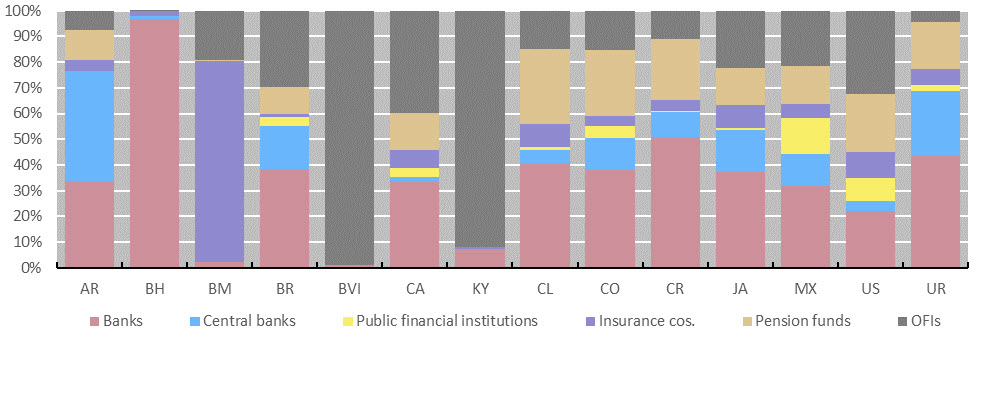
This report presents the results of the sixth non-bank financial intermediation (NBFI) monitoring exercise in the Americas. The exercise assesses the size, structure and recent trends of the NBFI sector in the region. The impact of the COVID-19 underlined the importance of this information in identifying potential risks to financial stability at the jurisdiction level, as well as those arising from potential cross-border linkages.
The report concludes that total financial assets in the region reached over $140trn at end-2019, with growth of 10.1% during 2019, faster than the annualised growth of 3.6% for the period between 2013 and 2018 and contrasting with the negligible annual contraction of 0.2% registered during 2018. The growth in total assets in 2019 was largely driven by the largest jurisdiction (United States), but growth was positive also in most other jurisdictions in the region.
The narrow measure, which covers NBFI activities that may pose bank-like financial stability risks, reached $27.7trn at end-2019, up from $24.4trn at end-2018, a faster growth rate (13.7%) than that observed in previous years (the compound growth rate for the 2013- 2018 period was 3.7%). Within the narrow measure, the fastest growth was in collective investment vehicles with features that make them susceptible to runs, which grew by 17.1% in 2019 and made up 76.2% of the narrow measure at end-2019.
This document has been prepared by the FSB RCG for the Americas and is being published to disseminate information to the public. The views expressed in the document are those of the RCG for the Americas and do not necessarily reflect those of the FSB.
3 December 2021 | PDF full text (759 KB)
This report tracks international progress in finalising standards and national and regional progress in implementing the G20 reforms to global over-the-counter (OTC) derivatives markets reforms following the 2008 Global Financial Crisis.
Overall implementation of the G20’s OTC derivatives reforms was already well advanced by 2020, but there has been further incremental progress across FSB member jurisdictions since the previous annual report in October 2020.
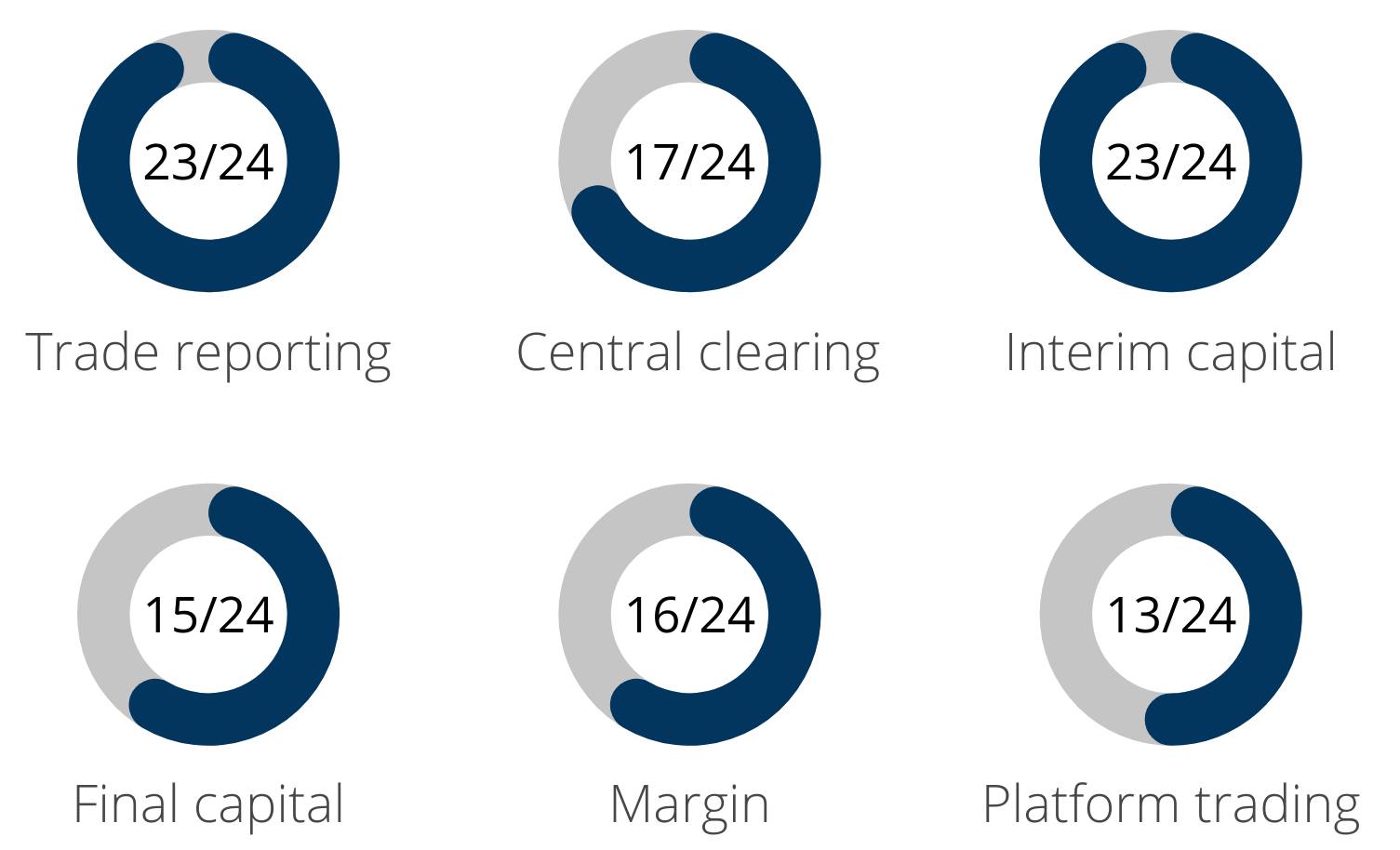
The report also notes that most jurisdictions have withdrawn or have not extended measures previously introduced to alleviate the operational burden for OTC derivatives market participants in response to COVID-19. Changes to market and counterparty credit risk frameworks and margin practices to limit and mitigate excessive procyclicality have been embedded into jurisdictions’ supervisory frameworks.
Press enquiries:
+41 61 280 8477
[email protected]
Ref: 39/2021
The Financial Stability Board (FSB) Regional Consultative Group (RCG) for the Middle East and North Africa (MENA) met today in virtual format.
Members discussed global and regional macro-financial vulnerabilities, including those stemming from the COVID-19 pandemic, their possible impact on RCG MENA member economies, and potential policy responses. As part of the discussion, members discussed initial lessons learnt from a financial stability perspective, and considered the potential implications for the region of exit measures taken in advanced economies.
Members also discussed the challenges in assessing climate-related financial risks and the implications of such risks for economies in the MENA region. Members exchanged views on policy priorities and regulatory and supervisory approaches for dealing with climate-related financial risks.
The group received an update on the FSB’s work programme for 2022, including deliverables to the Indonesian G20 Presidency, and discussed areas of particular relevance to the region where RCG MENA members could contribute their expertise.
The FSB RCG for the Middle East and North Africa is co-chaired by Şahap Kavcıoğlu, Governor, the Central Bank of the Republic of Turkey and Marouane El Abassi, Governor, Central Bank of Tunisia. Membership includes financial authorities from Algeria, Bahrain, Egypt, Jordan, Kuwait, Lebanon, Morocco, Oman, Qatar, Saudi Arabia, Tunisia, Turkey and the United Arab Emirates.
The FSB has six Regional Consultative Groups, established under the FSB Charter, to bring together financial authorities from FSB member and non-member countries to exchange views on vulnerabilities affecting financial systems and on initiatives to promote financial stability1. Typically, each Regional Consultative Group meets twice each year.
The FSB coordinates at the international level the work of national financial authorities and international standard-setting bodies and develops and promotes the implementation of effective regulatory, supervisory, and other financial sector policies in the interest of financial stability. It brings together national authorities responsible for financial stability in 24 countries and jurisdictions, international financial institutions, sector-specific international groupings of regulators and supervisors, and committees of central bank experts. The FSB also conducts outreach with approximately 70 other jurisdictions through its six Regional Consultative Groups.
The FSB is chaired by Klaas Knot, President of De Nederlandsche Bank. The FSB Secretariat is located in Basel, Switzerland, and hosted by the Bank for International Settlements.
2 December 2021
Press enquiries:
+41 61 280 8477
[email protected]
Ref: 38/2021
Klaas Knot today has taken office as Financial Stability Board (FSB) Chair, succeeding Randal K. Quarles.
Mr Knot is President of De Nederlandsche Bank (DNB). Prior to his appointment as Chair, Mr Knot had been serving as FSB Vice Chair and Chair of the FSB’s Standing Committee on Assessment of Vulnerabilities (SCAV).
FSB Plenary members, in their final meeting under Randal Quarles’ leadership on 18 November, expressed their gratitude to Randal Quarles for his leadership and commitment in chairing the FSB during the past three years, and looked forward to working with Klaas Knot.
Randal K. Quarles said “It has been an honor to serve as FSB Chair these last three years and to lead this important global organization during such a critical time. During the COVID Event, the FSB has proven its effectiveness as a mechanism to further global financial stability and support swift recovery. Our members, and the partnerships we have built, remain our greatest asset. As Klaas takes over from me, I know that I leave the FSB in safe hands.”
Klaas Knot added: “Under Randy’s leadership, the FSB demonstrated its vital role as a coordinating mechanism for financial authorities in the global response to COVID-19. I look forward to continuing the important work of the FSB at a time when the financial system is confronted by both structural changes and the need to provide financing to sustain a balanced economic recovery. The FSB, with its broad membership and diverse expertise, is uniquely placed to oversee further enhancements to the resilience and functioning of the financial system at this critical juncture.”
Klaas Knot succeeds Randal K. Quarles (Governor, US Federal Reserve), whose term of office as FSB Chair ended on 1 December 2021. Klaas Knot’s term as FSB Chair runs from 2 December 2021 until 1 December 2024.
The decision to appoint Mr Knot as FSB Chair was made on 26 November 2018. At that time, the FSB Plenary appointed Randal K. Quarles as its new Chair and Klaas Knot as Vice Chair, for a three-year term starting on 2 December 2018, and also agreed that after three years on 2 December 2021 Mr Knot would take over as Chair for the next three-year term.
The FSB Chair is selected from representatives on the Plenary and appointed by the Plenary for a term of three years, renewable once. The process for appointing the FSB’s Chair is set out in the FSB’s Procedural Guidelines and the Charter.
Klaas H.W. Knot has been President of De Nederlandsche Bank (DNB) since July 2011 and was reappointed for a second seven-year term as President of DNB in July 2018. In his capacity as DNB President, he is a member of the Governing Council of the European Central Bank, Governor of the International Monetary Fund, and member of the Board of Directors of the Bank for International Settlements and of the European Systemic Risk Board. He became Chair of the FSB’s Standing Committee on the Assessment of Vulnerabilities in September 2018 and, in addition, Vice Chair of the FSB in December 2018.
In 1991, Mr Knot graduated with honours in economics at the University of Groningen. In 1995, he obtained his PhD in economics. He is honorary Professor of Economics of Central Banking at the University of Groningen and of Monetary Stability at the University of Amsterdam.
Prior to becoming President of DNB, Mr Knot was Deputy Treasurer-General and Director of Financial Markets at the Dutch Ministry of Finance. He also held positions at DNB, the Pension and Insurance Authority, and the International Monetary Fund.
The FSB coordinates at the international level the work of national financial authorities and international standard-setting bodies and develops and promotes the implementation of effective regulatory, supervisory, and other financial sector policies in the interest of financial stability. It brings together national authorities responsible for financial stability in 24 countries and jurisdictions, international financial institutions, sector-specific international groupings of regulators and supervisors, and committees of central bank experts. The FSB also conducts outreach with approximately 70 other jurisdictions through its six Regional Consultative Groups.
The FSB Secretariat is located in Basel, Switzerland, and hosted by the Bank for International Settlements.
1 December 2021
Press enquiries:
+41 61 280 8477
[email protected]
Ref: 37/2021
The Financial Stability Board (FSB) Regional Consultative Group (RCG) for Sub-Saharan Africa held a virtual meeting today to discuss recent global and regional macroeconomic and financial market developments and their implications for financial stability.
Members considered the lessons learned so far from the COVID-19 pandemic for their jurisdictions and policy challenges stemming from the recent crisis, including trade-offs between keeping in place measures to support the financing of the real economy and preserving policy space. The response to COVID-19 should be based on scientific evidence and the supply of vaccines should consider the needs of developing countries. Members also reviewed vulnerabilities related to foreign currency funding, as illustrated by the external funding pressures experienced by emerging market economies during the March 2020 market stress.
Members discussed potential longer-term effects of the COVID-19 pandemic, including debt overhang and corporate viability issues, and their possible impact on the financial system’s resilience and ability to support economic growth.
The Group received an update on the FSB’s work programme for 2022, and discussed areas of the workplan of importance for Sub-Saharan Africa, such as the work on climate risks and on cross-border payments.
The FSB RCG for Sub-Saharan Africa is co-chaired by Lesetja Kganyago, Governor, South African Reserve Bank and Ernest Addison, Governor, Bank of Ghana. Membership includes financial authorities from Angola, Botswana, Ghana, Kenya, Mauritius, Namibia, Nigeria, South Africa, Tanzania, Uganda and Zambia as well as the Central Bank of West African States (BCEAO) and the Bank of Central African States (BEAC). Permanent observers include the Committee of Central Bank Governors of the Southern African Development Community, and the East African Community.
The FSB has six Regional Consultative Groups, established under the FSB Charter, to bring together financial authorities from FSB member and non-member countries to exchange views on vulnerabilities affecting financial systems and on initiatives to promote financial stability.1 Typically, each Regional Consultative Group meets twice each year.
The FSB coordinates at the international level the work of national financial authorities and international standard-setting bodies and develops and promotes the implementation of effective regulatory, supervisory, and other financial sector policies in the interest of financial stability. It brings together national authorities responsible for financial stability in 24 countries and jurisdictions, international financial institutions, sector-specific international groupings of regulators and supervisors, and committees of central bank experts. The FSB also conducts outreach with approximately 70 other jurisdictions through its six Regional Consultative Groups.
The FSB is chaired by Randal K. Quarles, Governor, US Federal Reserve; its Vice Chair is Klaas Knot, President of De Nederlandsche Bank. The FSB Secretariat is located in Basel, Switzerland, and hosted by the Bank for International Settlements.